The Russians shall not have Romania
An unusual street name leads us on an historical journey
©2006 David M Kidd Eighth Edition: 2026
In England, children play in many streets named Plevna, unaware of what that word means.
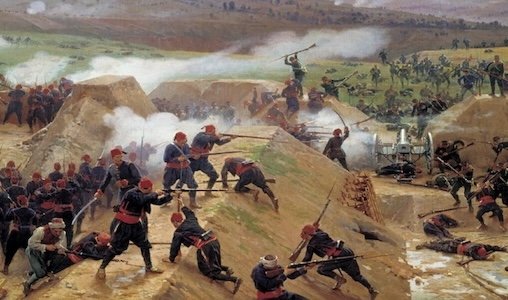
"Osman Pasha's defence of Plevna showed in the most striking way the value of improvised earthworks held by determined men." ~ "Famous Modern Battles" by A Hilliard Atteridge.
NEW eBOOK COMING SOON
There was a battle in 1877 during which the town suffered a 143-day siege. Since the houses in England were built during the Victorian period, it seems they were named after that battle. However, since it was a war that did not involve Britain at all, why were so many named?
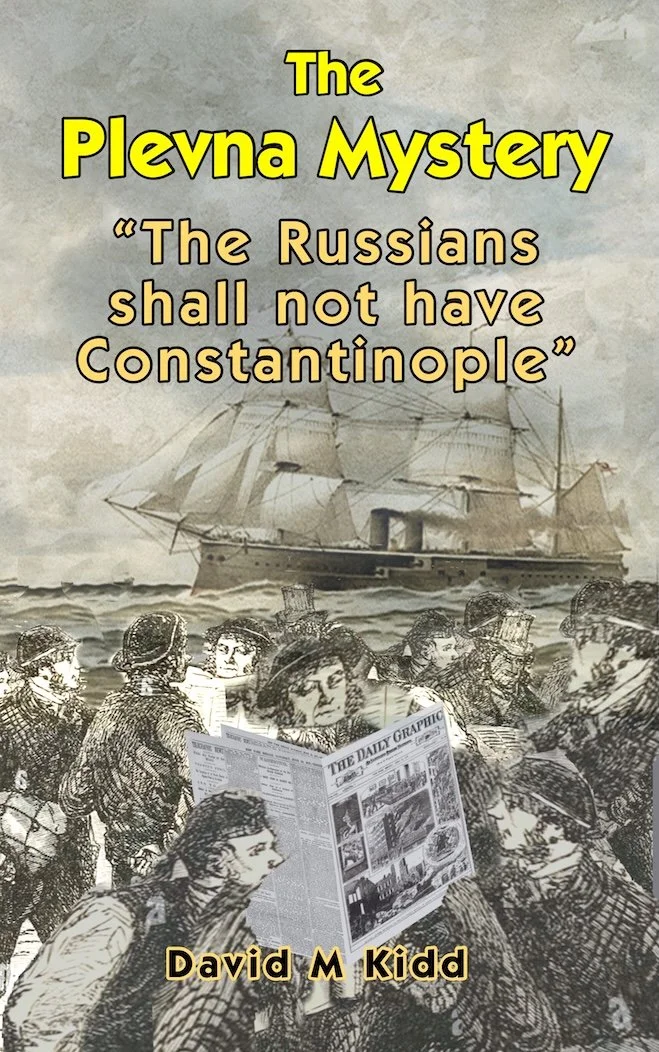
“The siege had held up the main Russian advance into Bulgaria and captured the world's admiration. ”
Surrender; 10 December 1877.
Osman Pasha did not submit to a Russian, but surrendered his sword to a Romanian General, Mihai Cerchez.
Osman's words were “I will hand over my sword to the brave Romanian army, for the only tactical success was obtained by the Romanian army by taking the Grivitza redoubt.” ~ Sorin, Adelaide.
CASUALTIES
Russian and Romanian 38,000 killed, wounded or captured.
Turkish 45,000 killed, wounded or captured.
THE TURKISH ARMY
"A handful of soldiers of a bedraggled army of Turks stopped cold the enormous forces of the Czar of Russia.... Pinned-down by a huge infantry surrounding them, being bombarded day and night by heavy artillery positions from all sides. They were cut off from all civilisation”.
The first Russian attack failed.... Europe was electrified by the news of the Russian defeat at Plevna. People could hardly believe that the mighty Russian hordes had been defeated by a handful of Turks. The name of Osman Pasha rang throughout the world.... The Czar issued orders to starve Plevna into submission. Thousands and thousands of fresh Russian troops were brought to the scene for the purpose of encircling and blockading the little town.
Days followed into weeks, weeks into months. The siege continued. Food and fuel supplies quickly ran out in Plevna.... The living were forced to eat the soles of their shoes to stay alive.
On December 10, the last battle of Plevna occurred. [Outnumbering the Turks almost 5 to 1, the Russians drove the Turks back across the Vid and wounded Osman in the process.] Believing that Osman was dead and not just wounded, the grief-stricken Turkish soldiers were in disarray.... surrendered to the Russians. All Europe was entranced by the heroism of Osman Pasha and his men. ”
“All over the continent of Europe, especially in England, hundreds upon hundreds of newborn babes were named after the Turkish general: Osman Pasha the "Turkish Tiger, who tamed the Russian bear."
But were English babies really named after Osman Pasha? Was that true or a wild exaggeration? I have found none in any reigister, However one of our readers has found a baby being named after Plevna: "My grandmother's cousin was named Plevna Mary Davies. She was born in Newcastle Emlyn, Carmarthenshire, Wales in the last quarter of 1883..
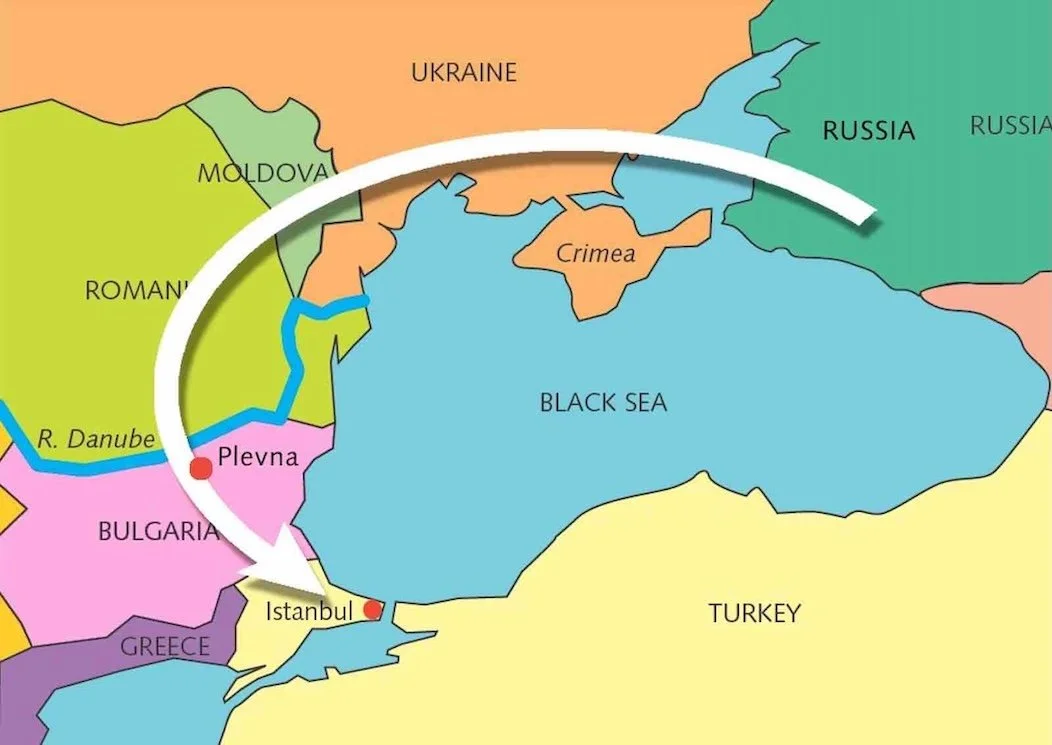
RUSSIA’S PLANNED INVASION OF ISTANBUL.
Copyright ©2016 David M Kidd
“The overall Russian intent had been to capture Constantinople so, for practical purposes, they planned to start the invasion was in Spring so as to pass over the Balkan Mountains in the warm season. However, after the siege of Plevna had delayed them by four months, a winter passing of the mountain doomed their success.” ~ Gospodin Borislav, of Pleven, Bulgaria
WE ARE NOT ALONE
Plevna Terrace, Great Yarmouth
Plevna Terrace, Sunderland, Durham
Plevna Terrace, Tywyn, Wales
Plevna Street, Poplar, London E14
Plevna Street, Hartlepool
Plevna Street, Bolton, Lancs BL2 2BY
Plevna Road, Hampton Village, Middlesex
Plevna Road, Enfield, London
Plevna Road, Edmonton, London N9 0BU
Plevna Road, Richmond, London TW12
Plevna Road. Stoke Newington, Middlesex
Plevna Place, Alton, GU34 2DS
Plevna Park, Edmonton, London
Plevna Park, Falls, Belfast, N. Ireland
Plevna Crescent, S.Tottenham, London N15
Plevna Crescent, Stoke-Newington
Plevna Crescent, Haringey
RUSSIA RETREATED
The Prime Minister ordered the Royal Navy’s Mediterranean Squadron to go and give the Russians a show of strength. A complement of 3,863 men sailed eight battleships carrying a total of 95 heavy guns of up to 12-inch (30 cm) bore, into the Turkish Straits, and, during a winter storm, made “a daring, high-stakes move” and moored beside Istanbul. The Russian army retreated.
BOTH SIDES
It seems as if both sides are proud. Two places in Russia are named after Plevna: "Plevna Chapel on St Elijah's Square in Moscow, opened in 1882, commemorates the Russian soldiers who died in the Battle of Pleven. "A large new factory building, completed in 1877, of the Finlayson & Co cotton mill in Tampere, Finland, was named Plevna, commemorating the battle.
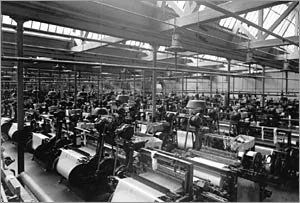
Some of the 1,200 power looms in Plevna cotton weaving mills, Finland
OTHER PLEVNAS
There are over five Plevnas in other countries:
Plevna Montana MT59344 population 138,
Plevna Kansas KS67568 population 99,
Plevna North Madison County AL, and
Plevna in Missouri MO67568 population 0.
Plevna in Ontario KOH 2MO population well over 200.
A Plevna Court in Parkwood, Perth, Australia.
THE BRITISH CONNECTION AT LAST
Finally I stumbled across the historical connection with England:
In Turkey, in about 1875, the party of Young Turkey was formed, desirous of reforming the empire on the European model. Two sultans, Abdul-Aziz and Murad, were successively deposed. A new sultan, Abdul-Hamid, proclaimed a constitution on 23 Dec 1876 resembling the European model, with a parliament and responsible ministers; but the reforming grand vizier Midhat Pasha was strangled, and the opening of parliament was no more than a comedy. Europe decided to act, and in 1877, Russia took the lead and sent an army across the Balkans, after the difficult siege of Plevna, and would have entered Constantinople had it not been for the intervention of the English fleet. So there we have British participation at last, it was the British Navy, not the Army, who made our link with Plevna.
Why were they so named? One Plevna was named by Bulgarians railway builders, but all the explanations I've received tell otherwise: The residents of Reno County, Kansas, say their Plevna's founders were Germans, and the town was first mentioned in 1879, so that leans towards the named-for-the-battle theory.
In 1877, the town of Buckshot, Ontario had to change its name but there was so much argument about it that a resident said this reminded him of the conflict in Plevna -- hence the name: Plevna Ontario
STILL THE QUESTION
Still my question remains unanswered: why this commemoration of a foreign war? Must we go further back in history to understand the circumstances? For the circumstances that brought about the situation in Plevna we must look back a long way.
THE STORY
Gospodin Borislav, of Pleven, Bulgaria, wrote “In Bulgaria, the primary hero here is the Russian General Skobelev, the ‘White General’, who always rode into battle dressed in white on a white horse, and never got hit by bullets. However, statistics prove that Skobelev's power was not supernatural; his soldiers were far from protected; in the third battle, he lost 12,814 of his men, while the Turks lost only 3,000. At the beginning, Osman Pasha was a hero for it did seem helpless for the Turks as the Russian spies reported there were so few Turks in Plevna that their task would be merely to “conquer a small town”. Yet Osman Pasha held out for several days, until he received reinforcements and the warfare soon shifted to a vast engagement. For the Russians, all three major battles were unsuccessful. It was not until October that the end came in view; General Eduard Totleben, Russia’s military engineer, traced Pleven’s water supply and cut it off. In the town, food preparation became progressively more difficult, so slowly but surely, the Turkish army was doomed.”
Twenty-first century.
In 2014, When Vladimir Putin invaded Crimea, he justified his annexation on the grounds that ‘Vladimir the Great’ was baptised there in year 998, therefore it is a Holy Ground of Russia. Putin recounts that he converted to Orthodox Christianity later in life; that he attend the major Orthodox services and seeks a close relationship with the church by defending traditional conservative values against the West. Yet even so, analysts question whether Putin's use of religious imagery is genuinely motivated, or is it a strategic display to legitimise his political actions. Perhaps Putin is bridging them both with the Caesaropapism of the 16th-century Czars
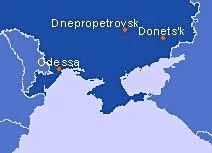
October 2023. The UK put surveillance monitors in the Black Sea to call out any further Russian attacks, and The USA announced “Our goal is a Black Sea region that is secure, prosperous, interconnected, and free from threats to territorial integrity and from economic coercion.”
The Russo-Ukraine naval war (2014-present): the naval war has received relatively little attention. The lion’s share of analysis focuses on the Army, yet Russia has clearly demonstrated that a strong naval presence is a national priority. The northern half of the Black Sea and the entire Sea of Azov is their primary naval theatre of the war. Russia has always wanted to rule the Black Sea, conquer the Bosphorus and the Dardanelles. Their enduring strategic goal and at the forefront of Russia’s strategic thinking is to secure unlimited access from the Black Sea, through Istanbul, to the eastern Mediterranean. Presently, Turkey gives NATO members free access through the Bosphorus, but in 1936, thirteen nations established the 1936 Montreux Convention: “Article 19. In wartime, if Turkey is not involved in the conflict, warships of any nations at war may not pass through the Straits, except when returning to their base.” Therefore, the most significant risk of escalation remains in the eastern Mediterranean, where, before hostilities began, the Russian Federation Navy assembled a naval task force of its most potent surface combatants and advanced diesel-electric submarines. In 2022, warships from all four of Russia’s fleets converged on the Eastern Mediterranean.
CONSEQUENCES
One interpretation is that Russia’s willingness to endure high losses to seize Ukrainian ports signals the sea’s importance to Putin’s vision for a revitalised Russia. According to these media, control of the Black Sea poses a major threat to NATO; thus, providing strong military, financial, and intelligence aid to Ukraine is necessary for self-defense. A second perspective extends the idea of a ‘proxy war’; suggesting that all major world powers—and their allies—are using the conflict to advance their interests. Some media speculate that China will become more involved, turning the conflict into a centre of global power competition. Some commentators challenge the ‘proxy war’ framing. They argue that it oversimplifies the conflict by overlooking Ukraine’s independent motivations for fighting for its sovereignty.
THIS IS NOT THE END. The entire Book goes further
copyright ©2026 David M Kidd
NEW eBOOK COMING SOON
“The Plevna Mystery”
How Russia’s invasions of the Balkans affect the British people.
This eBook will include what you’ve just read, but proceeds much further to describe the dramstic Situation in England • Dreams of a new Greece • Dizzy and Victoria • Disraeli’s foreign affairs • Gladstone’s baggage • Gladstone versus Disraeli • By jingo the song • McDermott’s war song • A Northern Echo • The Eastern Question• British preparations for war 1878 • The Secret Agreement • The Eastern Question in the north • Prime minister had to resign0 • Conclusion • Responses from our readers • Bibliography.